
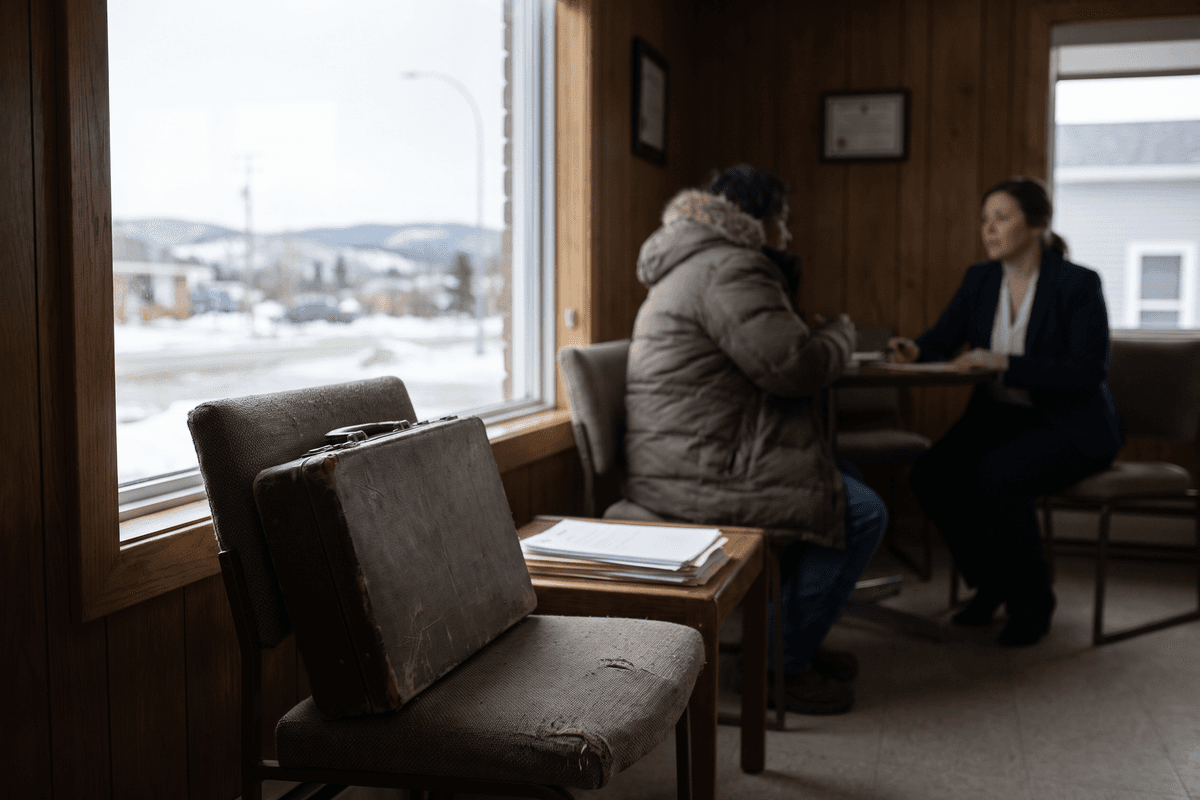

Imagine earning just enough to be ineligible for legal aid, but not nearly enough to pay a family lawyer's retainer. For a growing number of Yukon residents, that is not a hypothetical. It is the daily reality of what the Yukon Legal Services Society has described as a squeeze that leaves people in-between: too comfortable for public help, too constrained for the private market.
Defining the Gap
The warning, reported in a recent primary source, identifies two forces working together. The first is income eligibility caps that define who qualifies for publicly funded representation. The second is a territory-wide shortage of private family lawyers, which narrows the options for those who fall outside the cap. Neither problem is unique to the North, but in a jurisdiction with a small bar and dispersed communities, their combined effect is magnified.
Family law sits at the centre of the concern because its matters rarely wait. Parenting schedules, support obligations, and protection issues often arise under pressure, and the consequences of going unrepresented can be long-lasting. When a person cannot access counsel at the moment a decision is needed, the court process tends to proceed without them, and the imbalance on the record grows.
When eligibility thresholds are set without accounting for the cost of private representation, the people most likely to be turned away are those who were never poor enough to qualify but never comfortable enough to pay.
That tension is what makes the Yukon situation instructive beyond the territory. Eligibility formulas are typically built around a poverty line, yet the cost of a family law matter can exceed what a modest household can absorb without sacrificing basic needs. The result is a population that legal aid policy has not reached and that the private market is not positioned to serve at an affordable price.
Why the Private Market Cannot Fill the Space Alone
A shortage of private family lawyers compounds the eligibility problem in a way that is easy to underestimate. Where few practitioners take family files, clients may face long searches, limited availability, and fewer price points to compare. Lawyers who do practise in the area may have full caseloads, leaving them unable to accept new clients on terms that a modest-income household can afford.
This dynamic is not confined to the territories. Across Canada, the family bar has faced sustained pressure from court backlogs, complex parenting disputes, and the growing number of self-represented litigants. Practitioners considering where to build a practice should recognize that unmet demand in underserved regions is also a business signal, one that can be addressed through modest fee structures, clear scope definitions, and partnerships with community organizations.
Who Falls Into the Middle?
The gap does not affect everyone in the same way. The table below sets out common profiles and the practical choices each may face. It is a simplified framework, not a substitute for individual assessment, but it helps counsel and advocates think through options quickly.
| Client Profile | Typical Legal Aid Position | Typical Private Market Position | Practical Options |
|---|---|---|---|
| Low income, eligible for legal aid | Likely eligible, subject to matter and merit criteria | Generally unnecessary | Full representation through the legal aid system |
| Income slightly above the cap, modest savings | Ineligible or borderline | Full retainer may be unaffordable | Limited-scope retainer, unbundled services, duty counsel, or pro bono referral |
| Middle income, complex family matter | Ineligible | Available but costly; limited local supply | Mediation, fixed-fee arrangements, staged retainers, or advice-only engagements |
| Self-represented litigant needing procedural help | Not typically covered for procedural guidance alone | Limited-scope advice may be practical | Court-based information services, document review, and targeted coaching |
For practitioners, the middle rows are where the opportunity and the responsibility converge. Limited-scope retainers, sometimes described as unbundled services, allow a lawyer to assist with specific steps such as drafting, document review, or a single hearing without assuming full carriage of a file. Done properly, with clear written scope, disclosure of the limits, and attention to the client's understanding, these arrangements can widen access while managing risk.
The Wider Access-to-Justice Context
The Yukon warning does not exist in isolation. Several other developments in the same news cycle point to how legal services are being shaped by regulation, policy, and institutional pressure.
- Alberta's Bill 33: The National Employment Equity Council and Amnesty International Canada urged the government to withdraw proposed restrictions on employment equity and inclusion training in public institutions. Source
- Federal environmental law: Ecojustice criticized the federal government's decision not to appeal an Alberta Court of Appeal ruling that found parts of the amended Impact Assessment Act unconstitutional. Source
- British Columbia's Legal Professions Act: The CBA BC Branch has asked the incoming provincial government to open consultations on contentious reforms to the Act. Source
- Bench appointments: Ontario has added judges to the Ontario Court of Justice and the Ontario Superior Court of Justice, reflecting ongoing efforts to keep the courts staffed. Source
Taken together, these items show a profession and a policy environment in which access, representation, and regulatory design are closely linked. Decisions about who may practise, who may be funded, and which rights are protected by statute all shape whether a person can realistically reach a courtroom with competent help.
Access to justice is not a single program. It is the sum of eligibility rules, lawyer supply, fee structures, and the regulatory space that determines who can offer help and on what terms.
Practical Steps for Canadian Practitioners
For lawyers, legal aid administrators, and law societies, the Yukon warning suggests several concrete areas for attention:
- Map the middle. Identify the income and asset ranges where clients are neither eligible for public funding nor able to afford a full retainer, and track how many enquiries fall into that band.
- Build limited-scope capacity. Develop templated engagement letters and clear scope disclaimers so that unbundled work is efficient and defensible.
- Partner locally. Work with community legal clinics, court-based information services, and Indigenous and community organizations to route clients to the right level of help.
- Price for access. Consider fixed-fee and staged-fee models for predictable family matters, and document the reasoning behind fee decisions.
- Engage in consultation. Whether on eligibility criteria, regulatory reform, or service design, practitioners who participate in consultations shape the rules that determine who is served.
Looking Ahead
The Yukon Legal Services Society's warning is a reminder that access to justice is measured at the edges of eligibility, not only at its core. The people who fall between public funding and private affordability are often the least visible in policy debates, yet they encounter the courts in the most consequential moments of their lives.
Over the coming months, the central question for the profession is whether that middle group will be treated as a design problem to solve or an unavoidable byproduct of the system. Practitioners who begin mapping their own client gaps, building transparent limited-scope offerings, and engaging with eligibility reform will be better placed to answer that question, and to show that a more accessible justice system is both achievable and sustainable.