
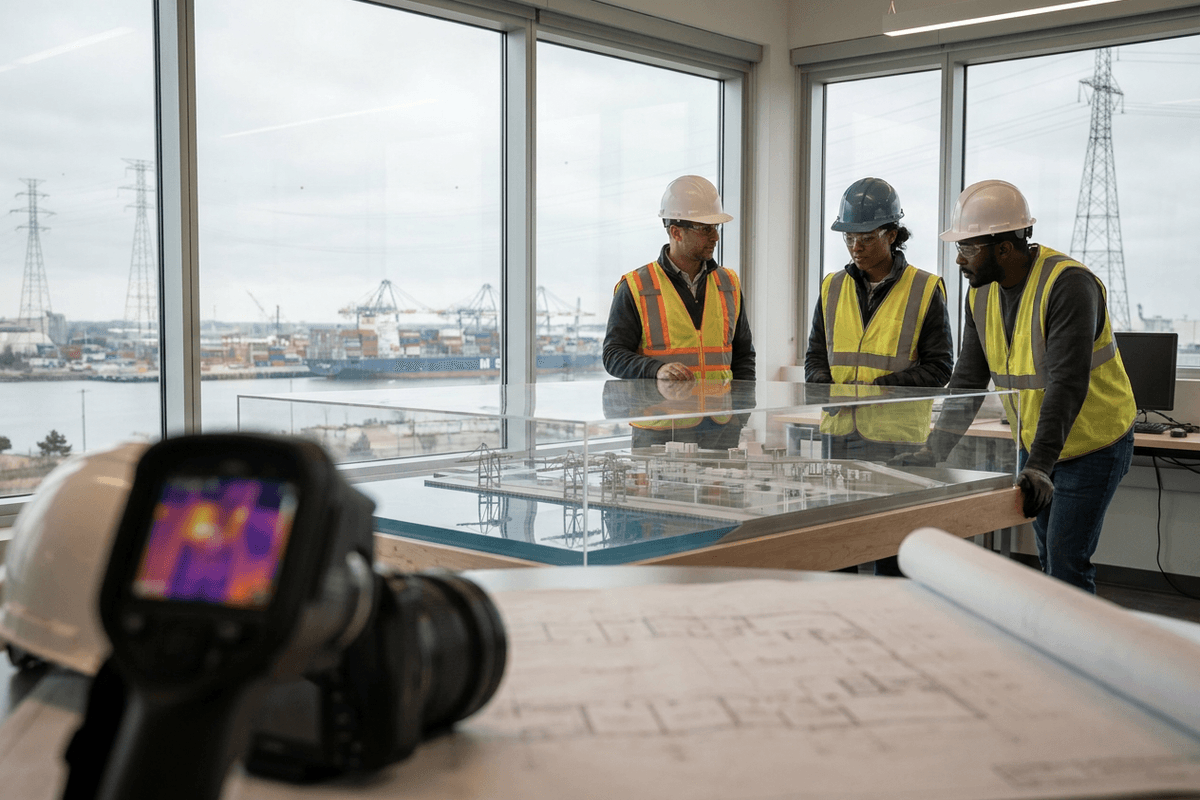

Across the American industrial landscape, engineering capacity is undergoing an aggressive, structural realignment toward high-density, mission-critical infrastructure. As hyperscale artificial intelligence architectures push thermodynamic thresholds beyond traditional cooling limits, and federal mandates accelerate baseline energy corridors, design-build firms are being forced to execute unprecedented feats of cross-disciplinary engineering. This physical transformation is visible not only in state-of-the-art domestic manufacturing facilities, but also in deepwater ports exploring small modular nuclear reactors and interstate pipeline corridors backed by national defense authorities.
Yet, as capital flows into complex mechanical, civil, and energy assets, the industry faces an intensifying paradox: surging project backlogs and institutional momentum are colliding directly with severe labor constraints in specialized engineering disciplines. Balancing this unprecedented demand with execution bandwidth has become the central operational challenge for U.S. engineering leadership.
The Thermal Hardware Crucible: Inside Carrier’s $600M Advanced Manufacturing Hub
The operational reality of next-generation data infrastructure is that computation cannot exist without advanced thermodynamics. Demonstrating the magnitude of this hardware shift, Carrier Global announced a $600 million investment over three years into a new advanced manufacturing and engineering center in Fort Worth, Texas. The facility is slated to create 1,500 high-skilled jobs, anchoring the domestic supply chain for high-efficiency thermal management solutions, modular chillers, and liquid-cooling distribution units.
For systems engineers, the technical implications are profound. Modern graphics processing unit (GPU) clusters generate heat fluxes that make legacy air-handling systems obsolete, requiring direct-to-chip liquid cooling, closed-loop dielectric loops, and high-capacity coolant distribution units (CDUs). Carrier’s capital deployment signals that domestic engineering and manufacturing capacity must scale in lockstep with silicon evolution.
"The convergence of high-density silicon packaging and mega-wattage mechanical cooling has effectively turned data center delivery into a continuous fluid dynamics and thermodynamics challenge, requiring customized offsite fabrication at massive industrial scale."
The ENR Top 600 Reality: Revenue Surges Collide With Human Capital Bottlenecks
While mechanical equipment manufacturers scale their production footprints, specialty contractors and engineering consultancies are feeling the strain on their project execution pipelines. According to the latest findings from Engineering News-Record’s Top 600 specialty contractors survey, the unprecedented surge in data center development across the United States is propelling top-line revenue growth to record highs, but the availability of seasoned engineering and construction talent is failing to keep pace.
The bottleneck is particularly acute in mission-critical disciplines:
- High-Voltage and Substation Electrical Engineering: Engineering teams capable of designing dual-feed, 230kV-to-medium-voltage industrial substations are operating at capacity.
- Hydronics and Computational Fluid Dynamics (CFD): Specialty mechanical modelers capable of simulating complex liquid cooling manifolds in dense multi-story layouts are in critically short supply.
- Commissioning and Integrated Testing Agents: High-reliability facility validation requires specialized systems engineers who understand both software automation (BMS/EPMS) and heavy switchgear mechanics.
Contractors are increasingly turning to industrialized construction—such as pre-racked mechanical rooms, modular electrical skids, and standardized multi-trade assemblies—to shift labor hours away from congested jobsites into controlled factory environments.
Capital Realignment: Dodge Starts Reveal Civil and Energy Resilience
The demand for complex engineering capacity is not confined to the digital sphere. The macro-environment reflects a fundamental reallocation of capital away from light commercial and residential work toward complex infrastructure. Recent data from the Dodge Construction Network reveals that institutional and civil nonbuilding engineering projects have helped offset contractions in single-family residential construction across the United States.
This structural resilience is supported directly by federal energy initiatives. Highlighting the critical role of pipeline and civil engineering in domestic supply reliability, the U.S. Department of Energy allocated up to $42 million under Defense Production Act authorities to finance environmental engineering, design, and pre-construction activities for the 125-mile Constitution Pipeline.
| Engineering Sector | Primary Driver | Key Technical Milestone / Investment | Critical Resource Constraint |
|---|---|---|---|
| Thermal Systems | AI rack density & hyperscale cooling | $600M Carrier advanced manufacturing campus (TX) | Specialized fluid dynamicists & modular fabricators |
| Civil Energy Corridors | Grid reliability & baseline gas delivery | $42M DPA environmental & design grant (Constitution Pipeline) | Geotechnical permitting & linear environmental engineers |
| Portside Nuclear / Maritime | Decarbonized shore power & propulsion | Port of Long Beach & SC Ports SMR integration studies | Nuclear containment & marine regulatory specialists |
| Mission-Critical MEP | Data center facility scaling | ENR Top 600 revenue expansion | High-voltage commissioning & MEP project managers |
The Maritime Frontier: Small Modular Reactors at Commercial Ports
Perhaps the most forward-looking engineering frontier is unfolding at the intersection of heavy civil maritime infrastructure and nuclear technology. As ports face massive electrical demand from vessel cold ironing, shore-to-ship cranes, and drayage truck fleet electrification, conventional grid interconnections are proving insufficient.
In response, global shipping leader Maersk and major port authorities, including South Carolina Ports and the Port of Long Beach, are advancing engineering and regulatory feasibility studies into nuclear propulsion integration and small modular reactor (SMR) infrastructure. These studies evaluate siting micro-reactors directly within port boundaries to serve as dedicated, zero-carbon baseload power plants.
Engineering Challenges in Portside SMR Siting
- Seismic and Geotechnical Siting: Engineering portside foundations requires specialized deep-pile dynamics and liquefaction mitigation to meet stringent Nuclear Regulatory Commission (NRC) seismic thresholds.
- Physical Security and Thermal Heat Sink Integration: Integrating marine cooling intakes while adhering to strict environmental thermal-discharge limits in protected coastal estuaries.
- Dual-Use Bunkering and Shore Interfaces: Creating modular high-voltage interconnects capable of rapid coupling with nuclear-propelled commercial vessels without disrupting container throughput.
Strategic Blueprint for Engineering Firms
For executive engineers, program directors, and technical consultants, navigating this multifaceted infrastructure expansion requires deliberate strategic adjustments:
- Vertical Integration of Digital Tooling: Invest in high-fidelity computational modeling—from transient computational fluid dynamics (CFD) for liquid data halls to 4D GIS environmental routing for linear energy corridors.
- Offsite Pre-Assembly Mandates: Structure contracts to favor Design for Manufacturing and Assembly (DfMA). Shifting mechanical skids, valve matrices, and transformer assemblies to offsite facilities reduces site labor bottlenecks by up to 35%.
- Cross-Sector Workforce Upskilling: Bridge traditional civil and industrial engineering siloes by training civil project managers in nuclear compliance frameworks and cross-training industrial MEP engineers in utility interconnection standards.
The U.S. engineering sector is operating at an inflection point. Whether inside Carrier’s $600 million thermal manufacturing facility, along federal pipeline rights-of-way, or across commercial shipping berths preparing for nuclear integration, the mandate is unambiguous: engineering firms that successfully master technical complexity and optimize scarce human capital will define the next generation of American infrastructure.