
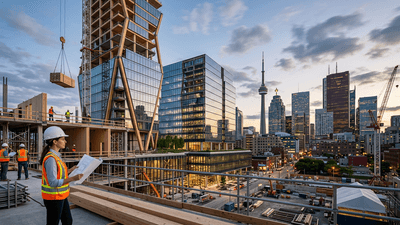



For Canadian architects, 2026 is shaping up to be a year defined by a singular, persistent friction: the widening gap between national ambition and economic reality. As we move deeper into the decade, the architectural profession is no longer just about designing the future; it is increasingly about negotiating the complex, often contradictory forces required to actually build it. From massive federal housing mandates to fraught civic infrastructure projects, the mandate for practitioners has shifted from unbridled visionary design to highly calculated pragmatism.
Recent industry forecasts and high-profile project developments paint a complex picture for the year ahead. While the volume of work is growing, the margins for error—both financial and political—have never been thinner. To thrive in this environment, architectural firms must evolve into highly adept risk managers, political navigators, and masters of constructability.
The Macro View: Growth Amidst Headwinds
The overarching narrative for the industry this year is one of constrained optimism. According to a recent industry report, Canada’s construction sector is expected to see increased activity in 2026, but these gains are heavily tempered by rising costs and lingering economic uncertainty.
For architectural practices, this "limited gain" environment translates directly into how projects are conceived and delivered. The era of cheap capital that fueled speculative, highly bespoke developments has definitively ended. Clients are demanding rigorous value engineering earlier in the schematic design phases. The increased activity noted in the report is largely driven by necessary infrastructure, institutional mandates, and targeted residential growth, rather than luxury commercial or vanity projects.
The Infrastructure Reality Check: Lessons from the West Coast
If there is a cautionary tale for large-scale project delivery in 2026, it can be found on the West Coast. Metro Vancouver and Acciona Wastewater Solutions recently reached a staggering $235 million settlement over the heavily delayed and over-budget North Shore Wastewater Treatment Plant.
While primarily an engineering and construction dispute, the fallout reverberates deeply through the architectural community. Massive civic infrastructure projects—often delivered through complex Public-Private Partnerships (P3s) or Design-Build models—require architectural consortiums to shoulder significant design liability. The North Shore settlement underscores the fragility of these mega-contracts in an era of supply chain volatility and labor shortages.
- Hyper-Vigilant Contract Administration: Architects must ensure their scopes of work, liability caps, and dispute resolution mechanisms are ironclad.
- Managing Client Expectations: The political fallout of delayed civic projects is immense. Architects must act as grounded advisors, pushing back against unrealistic timelines during the RFP phase.
- Agile Design Delivery: Projects must be designed with material substitutions and phased construction in mind to mitigate supply chain shocks.
"The days of the 'blank cheque' civic project are over. Public scrutiny on budget overruns is at an all-time high, forcing design teams to prioritize defensive, highly resilient detailing over experimental delivery methods."
Policy vs. Production: The Housing Paradox
Nowhere is the tension between ambition and reality more pronounced than in the residential sector. The federal government is maintaining its aggressive commitment to double the pace of housing construction over the next decade to combat the affordability crisis. Yet, this pledge is running headlong into severe industry headwinds, including municipal zoning bottlenecks, high interest rates, and a persistent shortage of skilled trades.
For architects, this paradox presents both a massive opportunity and a profound operational challenge. Ottawa's targets cannot be met using traditional, site-built, bespoke residential design models. The profession must pivot toward systemic solutions:
- Embracing Modular and Prefabrication: To meet federal volume targets, architects must design for off-site manufacturing, requiring a shift from traditional CAD workflows to Manufacturing-Informed Design (MID).
- Standardization of Missing Middle Housing: Firms that develop pre-approved, highly adaptable templates for mid-rise and multi-unit residential buildings will capture significant market share as municipalities look to fast-track approvals.
- Advocating for Code Harmonization: Architects must use their institutional voice to push for standardized building codes across jurisdictions, reducing the friction of local variances.
The Urban Tug-of-War: Infrastructure, Politics, and Placemaking
Beyond the economics of construction, Canadian architects in 2026 are increasingly caught in the crossfire of urban politics. The physical development of our cities is highly contested, requiring practitioners to be as adept at community consultation as they are at spatial planning.
The Billy Bishop Expansion Debate
A prime example is the ongoing friction on Toronto's waterfront. A coalition of former Toronto mayors is urging the federal government to block the expansion of Billy Bishop Airport, citing severe concerns over its impact on waterfront redevelopment and public realm integration.
This debate highlights a critical reality for urban design professionals: large-scale infrastructure is never politically neutral. Architects involved in waterfront revitalization, transit-oriented development, or aviation infrastructure must design for multiple, often opposing, stakeholder groups. The success of a master plan today hinges on its ability to demonstrate public benefit—such as expanded parklands, active transportation links, and ecological restoration—to offset the heavy footprint of urban infrastructure.
Sankofa Square’s Cultural Intervention
Conversely, while macro-infrastructure faces intense political gridlock, micro-interventions are proving highly successful at reshaping the public realm. In the heart of Toronto, Sankofa Square is featuring new site-wide installations by four artists, selected by a community-led jury.
This initiative transforms everyday infrastructure into public art, serving as a masterclass in tactical placemaking. For architectural practices, the lesson is clear: when large-scale developments stall due to economic or political headwinds, there is immense value in focusing on the "spaces between." Integrating community-led art, flexible public seating, and culturally resonant wayfinding into existing infrastructure can deliver immediate, tangible value to the public while larger projects navigate bureaucratic delays.
Strategic Imperatives for Canadian Firms in 2026
To navigate this landscape of constrained growth, legal caution, and political friction, architectural practices must recalibrate their strategic priorities. The table below outlines the shift required to succeed in the current climate.
| Market Challenge | Traditional Approach | The 2026 Pragmatic Pivot |
|---|---|---|
| Economic Uncertainty | Value engineering post-tender. | Targeted cost-consulting during schematic design; designing for material substitution. |
| Housing Mandates | Bespoke, site-specific residential design. | Developing scalable, modular, and pre-approved housing templates. |
| Infrastructure Risk | Accepting broad liability in P3/Design-Build. | Rigorous contract negotiation; defensive detailing; realistic timeline advocacy. |
| Urban Politics | Designing in isolation for the client. | Proactive community engagement; embedding public art and civic benefit into private projects. |
Conclusion: The Architect as Pragmatic Visionary
The narrative of Canadian architecture in 2026 is not one of decline, but of intense maturation. The anticipated increase in construction activity offers a steady pipeline of work, but the barriers to executing that work—rising costs, legal liabilities, political standoffs, and aggressive policy mandates—require a new kind of architectural practice.
The successful architect of 2026 is a pragmatic visionary. They are professionals who understand that a brilliant design is only as good as its constructability, its contractual safeguards, and its political viability. Whether navigating the macro-economics of federal housing pledges or the micro-cultural impacts of public squares, Canadian architects must embrace the friction of reality, using it not as a constraint, but as the very foundation of their design process.