
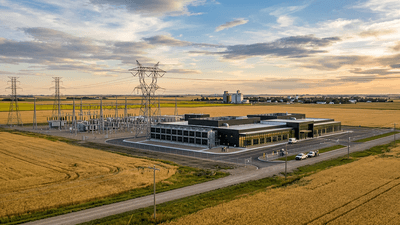



Beneath the sweeping skies of the Canadian prairies, a new kind of infrastructure boom is taking root—one that trades grain silos for server racks and combines rural isolation with hyper-dense computing. As a Saskatchewan rural municipality council prepares to vote on a proposed Bell Canada AI data centre, the conversation has rapidly shifted from local zoning to complex macro-engineering. For Canadian engineering professionals, this development signals a critical pivot: the frontlines of digital infrastructure are moving to rural Canada, bringing unprecedented challenges in power distribution, thermal management, and civil design.
Artificial Intelligence is not just a software revolution; it is a heavy-industry proposition. The sheer computational density required to train and run large language models (LLMs) demands infrastructure that traditional data centres simply cannot support. As telecom giants like Bell Canada look to rural regions to house these monolithic facilities, electrical, mechanical, and civil engineers are being forced to rewrite the playbook on grid integration and site sustainability.
The Megawatt Challenge: Rewiring the Rural Grid
The most immediate hurdle facing the Bell Canada proposal—and similar projects across the country—is electrical capacity. Rural grids were historically designed for agricultural, residential, and light industrial loads. Introducing an AI data centre is akin to dropping a medium-sized city's power demand into a single rural parcel.
Substation and Transmission Upgrades
Traditional cloud data centres typically operate at rack densities of 5 to 10 kilowatts (kW). AI data centres, packed with power-hungry GPUs, routinely push rack densities to 40 kW, 60 kW, or even upwards of 100 kW. This exponential increase requires robust electrical engineering solutions at the transmission level.
- High-Voltage Direct Current (HVDC) Integration: Engineers must design new substations capable of stepping down massive high-voltage transmission lines to usable facility power without destabilizing the local rural grid.
- Grid Interconnection Studies: Extensive dynamic load modeling is required to ensure that the rapid power fluctuations characteristic of AI training workloads do not cause frequency deviations on SaskPower's network.
- On-Site Microgrids: To mitigate grid strain, engineers are increasingly incorporating battery energy storage systems (BESS) and backup generation directly into the facility design, creating hybrid microgrids that can island themselves during peak provincial demand.
"We are no longer designing data centres; we are designing heavy-industrial power plants that happen to compute. The electrical infrastructure required to support AI necessitates a fundamental redesign of how we route, step down, and condition power in rural environments."
Thermal Management: From HVAC to Direct-to-Chip
Where there is massive power consumption, there is massive heat generation. Mechanical engineers tasked with designing these facilities are moving away from traditional air-cooling methods, which are physically incapable of managing the thermal output of high-density AI clusters.
Saskatchewan's climate offers a unique engineering advantage: free cooling. For over half the year, the ambient outside air is cold enough to chill the water loops used in data centre HVAC systems without the need for energy-intensive mechanical chillers. However, the density of AI chips is forcing a transition from air to liquid.
- Direct-to-Chip Liquid Cooling (DLC): Coolant is piped directly to cold plates mounted on the GPUs, capturing heat at the source. This requires intricate plumbing networks within the server racks, demanding precise fluid dynamics engineering to prevent leaks and ensure uniform flow.
- Immersion Cooling: An emerging standard where entire server chassis are submerged in dielectric fluid. Mechanical engineers must design robust containment, filtration, and heat-exchange systems to manage these heavy, fluid-filled tanks.
Comparing Infrastructure Demands
| Metric | Traditional Cloud Data Centre | AI Data Centre (Proposed) | Engineering Impact |
|---|---|---|---|
| Power Density | 5 - 15 kW per rack | 40 - 120+ kW per rack | Requires advanced power busways and localized transformers. |
| Cooling Method | CRAC units, Raised Floor Air | Direct-to-Chip Liquid, Immersion | Shift from HVAC ducting to complex fluid piping and heat exchangers. |
| Water Usage | Moderate (Evaporative) | High (if using traditional cooling towers) | Demands closed-loop systems to preserve rural water tables. |
| Structural Load | Standard commercial loads | Heavy industrial loads | Reinforced concrete slabs required for liquid-filled racks and heavy UPS systems. |
The Water-Energy Nexus in Prairie Engineering
Civil and environmental engineers face their own set of challenges with rural data centres, particularly concerning the water-energy nexus. In agricultural heartlands like Saskatchewan, water is a precious commodity. Traditional data centres rely heavily on evaporative cooling towers, which can consume millions of gallons of water annually.
To secure municipal approval and maintain environmental compliance, engineers must design closed-loop cooling systems that recycle water, or utilize zero-water cooling technologies. Furthermore, the civil infrastructure required to support these facilities goes beyond the building envelope. Engineers must design reinforced access roads capable of handling heavy construction equipment and transport trucks carrying massive generators, as well as trenching for redundant, high-capacity fiber optic backbones that connect these isolated sites to global networks.
Conclusion: The New Frontier of Canadian Infrastructure
The upcoming municipal vote on Bell Canada's proposed AI data centre in Saskatchewan is more than a local zoning decision; it is a bellwether for the future of Canadian digital infrastructure. As the AI arms race accelerates, the demand for megawatt-scale facilities will continue to push tech companies out of grid-locked urban centres and into rural municipalities.
For Canada's engineering sector, this rural AI boom offers a lucrative and technically demanding frontier. It requires a multidisciplinary approach—merging high-voltage electrical distribution, advanced fluid-dynamic mechanical cooling, and sustainable civil design. By successfully engineering these rural mega-facilities, Canadian professionals are not just building data centres; they are laying the heavy-industrial foundation for the next generation of global artificial intelligence.