
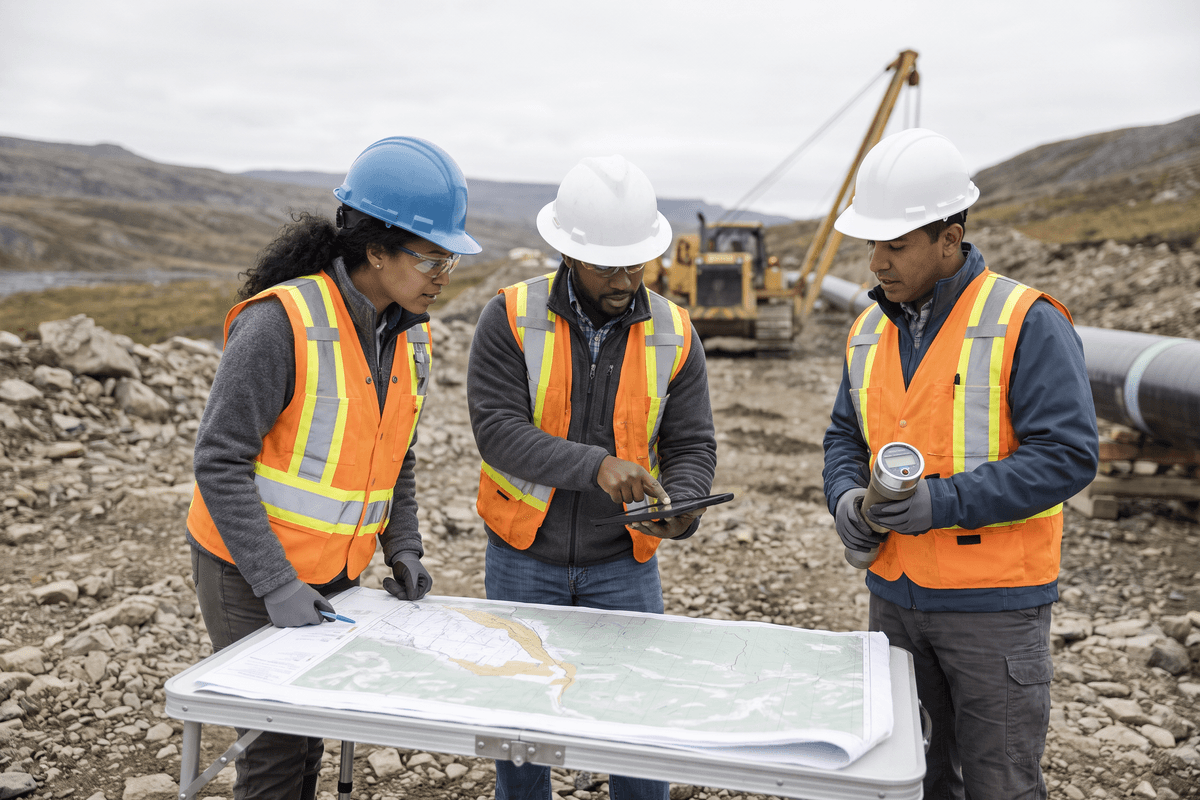



In an aggressive move that signals a decisive shift in how Washington approaches domestic energy security and heavy civil delivery, the U.S. Department of Energy (DOE) has intervened directly in regional pipeline infrastructure. By committing up to $42 million in Defense Production Act (DPA) Title III funding to advance pre-construction engineering, environmental reviews, and site preparation for the long-contested 125-mile Constitution Pipeline project, the federal government is reframing linear energy corridors as vital national defense assets. For project managers, geotechnical specialists, and environmental engineering executives across the United States, this injection of capital is not merely a bureaucratic milestone—it represents a profound transformation in how high-stakes energy infrastructure is funded, permitted, and built under heightened safety and compliance scrutiny.
Federal Realignment: The Defense Production Act and Linear Infrastructure
Historically reserved for critical mineral extraction, defense industrial tooling, and emergency manufacturing, Title III of the Defense Production Act has rarely been applied directly to natural gas transmission design and pre-development. The DOE's $42 million allocation for the Constitution Pipeline—a 125-mile route engineered to link Marcellus Shale production in northeastern Pennsylvania with high-demand transmission corridors across New York and New England—demonstrates that federal authorities increasingly view midstream energy transmission through the lens of strategic resilience.
For lead engineering firms, this federal funding shifts the risk calculus of Front-End Engineering Design (FEED) and pre-construction site evaluation. Front-loading public capital into advanced alignment surveys, geotechnical boreholes, and hydraulic modeling allows engineering teams to tackle baseline technical hurdles before initiating full capital-expenditure field mobilization:
- Advanced Route Geometrics and Terrain Optimization: Utilizing high-resolution LiDAR, multi-spectral GIS mapping, and automated slope-stability analytics to navigate complex Appalachian topography and sensitive hydrological basins.
- Hydrodynamic Modeling and Pipe Metallurgy: Engineering heavy-wall line pipe, fracture-arresting metallurgical specifications, and multi-tier cathodic protection systems designed to withstand cyclic loading and regional soil corrosivity.
- Pre-Emptive Right-of-Way (ROW) Preparation: Conducting precision grading assessments and civil site prep along narrow construction corridors to minimize off-site environmental disturbance.
"Treating natural gas transmission corridors as strategic defense assets under the DPA changes the financial and regulatory engineering baseline, accelerating pre-construction milestones while raising expectations for technical rigor."
The Execution Crucible: Geotechnical Safety and Deep Excavation Realities
While federal backing accelerates pre-construction engineering, execution in the field remains governed by unforgiving civil and geotechnical realities. Moving millions of cubic yards of earth across complex regional geology requires rigorous adherence to structural safety standards. The risks of cutting corners or failing to enforce strict excavation design are currently on display elsewhere in the region, where federal safety regulators at OSHA proposed $648,000 in penalties against six construction and engineering contractors following severe violations at a 75-foot deep excavation site in Monroe, New York.
The Monroe enforcement action underscores a critical lesson for linear and heavy civil engineering teams: project speed can never outpace structural excavation safety. In steep-slope pipeline trenching, river crossings, and deep valve vault installations, engineering leadership must implement robust geotechnical safety protocols:
- Dynamic Soil Classification and Bench Testing: Continuous on-site geotechnical logging to verify that cohesive, granular, and fractured rock layers match theoretical boring logs before benching or trenching begins.
- Engineered Shoring and Trench Box Deployment: Mandating site-specific, Professional Engineer (PE)-stamped shoring, soil nailing, or soldier pile systems for all deep civil cuts exceeding standard trench box depths.
- Continuous In-Situ Slope Stability Monitoring: Deploying automated total stations, borehole inclinometers, and tilt sensors to detect sub-millimeter ground displacement in real time around high-risk excavations.
| Engineering Focus Area | Primary Technical Challenge | Execution & Mitigation Strategy |
|---|---|---|
| Linear Trenching & Vaults | Unstable cohesive soils, high hydrostatic pressure, deep cuts | PE-stamped engineered shoring systems, dynamic benching, active dewatering |
| Steep-Slope Construction | Appalachian ridge crossings, slope slippage, equipment stability | Winch-assisted heavy machinery, multi-layer geosynthetic stabilization, drainage interceptors |
| Environmental Crossings | Wetland integrity, stream bed erosion, aquatic habitat disruption | Horizontal Directional Drilling (HDD), microtunneling, real-time turbidity telemetry |
| Regulatory Compliance | Multi-jurisdictional permitting, strict OSHA/FERC oversight | Integrated safety/environmental audits, digital twin ROW logging, unified site command |
The Strategic Role of Environmental Advisory and Multi-Tier Permitting
Federal DPA funding alone cannot insulate a major energy corridor from environmental and regulatory headwinds. To translate pre-construction capital into successful commercial operation, pipeline developers rely heavily on specialized technical advisory and environmental consulting firms. The growing influence of these disciplines is reflected across the industry, exemplified by firms like Cadmus earning a top ranking on ENR's Top 200 Environmental Firms list for delivering integrated engineering, climate, and water infrastructure solutions.
On complex 100-plus-mile linear builds, environmental engineering is no longer an afterthought confined to downstream permit filings; it is embedded directly within the FEED workflow. Modern environmental advisory teams provide critical cross-functional capabilities:
- Hydrological and Aquifer Protection: Comprehensive baseline water quality monitoring and 3D subsurface flow modeling to safeguard local groundwater tables and municipal watersheds along the alignment.
- Microtunneling and HDD Engineering: Designing complex trenchless crossings beneath sensitive riverbeds and protected state wetlands to bypass surface disruption entirely.
- Emissions and Fugitive Gas Mitigation: Integrating predictive valve diagnostics, continuous acoustic leak detection, and low-bleed pneumatic hardware into compressor station mechanical engineering.
Bridging the Execution Gap in Modern Infrastructure Delivery
The convergence of direct federal intervention via the DPA, strict OSHA civil excavation enforcement, and sophisticated environmental engineering frameworks points toward a new paradigm for American industrial project delivery. Engineering procurement and construction (EPC) leaders can no longer operate in siloed domains where civil design, field execution, and regulatory advisory function independently.
To successfully navigate this evolving landscape, project directors must establish unified operational dashboards that synthesize geotechnical sensor data, excavation safety checklists, and environmental compliance logs into a single digital management twin. By doing so, engineering teams can de-risk projects against multi-million-dollar OSHA citations and regulatory delays while maximizing the strategic velocity enabled by federal funding.
The Road Ahead: Building America's Resilient Energy Backbone
As the $42 million in DOE Title III capital flows into pre-construction engineering, geotechnical surveys, and environmental permitting along the Constitution Pipeline corridor, it sets a precedent for how future critical infrastructure will be advanced in contested operating environments. National security mandates and energy reliability requirements are increasingly driving federal policy, but the success of these massive investments ultimately rests on the technical discipline of engineering professionals in the field.
The coming years will test whether U.S. engineering and construction teams can integrate advanced trenchless technologies, zero-compromise geotechnical safety standards, and robust environmental stewardship into a repeatable execution model. For the engineers charting these pathways, the mandate is clear: build with strategic speed, design with environmental precision, and execute with absolute safety on the ground.