



Canada’s engineering landscape is undergoing a deliberate, geopolitical reorientation. As continental security imperatives intersect with global resource demands, the domestic consulting engineering sector is pivoting toward strategic frontiers that demand unprecedented cold-climate capability, autonomous data capture, and massive infrastructure scaling. At the centre of this shift is Edmonton-based engineering powerhouse Stantec, where incoming CEO Susan Reisbord has staked out clear growth vectors in Arctic infrastructure, national defence engineering, and critical mineral project development. Far from business-as-usual civil delivery, this evolution reflects a Canadian market where engineering consultancies are transitioning into frontline strategic partners for sovereign security, global energy trade, and northern industrial resilience.
The Arctic and Defence Pivot: Cold-Climate Engineering as Strategic Asset
For decades, Canadian northern engineering was treated as a specialized niche—defined by seasonal logistics windows, permafrost geotechnical risk, and high mobilization costs. Today, shifting geopolitical dynamics in the circumpolar region and escalating federal commitments to continental defence have elevated Arctic capability into a premier growth market. Major consultancies are realigning multidisciplinary teams to address everything from dual-use runway expansions and deep-water northern ports to resilient, off-grid energy systems for remote military installations.
"There is clear room to grow across Arctic projects and defence infrastructure. As northern sovereignty, critical mineral supply chains, and environmental resilience converge, the technical complexity required in cold regions represents one of the most demanding and essential frontiers for engineering consultancies."
Under Susan Reisbord’s upcoming leadership at Stantec, the consultancy is positioning itself to capture significant federal and multilateral procurement across the North. This includes engineering support for North American Aerospace Defense Command (NORAD) modernization, coastal surveillance infrastructure, and ground-truth geotechnical monitoring over degrading permafrost formations. The challenge for engineering firms is technical as much as operational: designing foundation systems and building envelopes that survive minus-50°C operating envelopes while accounting for accelerated thaw-settlement dynamics driven by climate warming.
Field Robotics and Autonomous Surveying: Bridging Remote Geotechnical Gaps
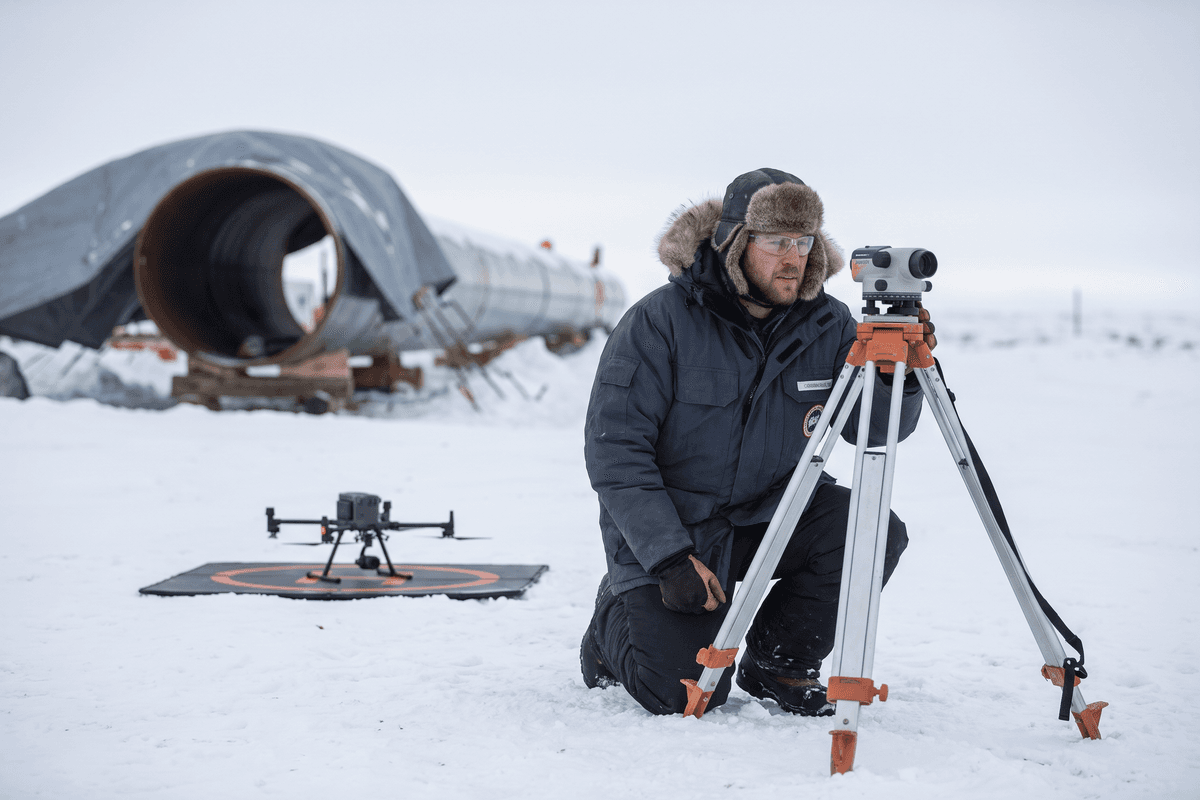
Executing major infrastructure and mineral development across Canada’s rugged interior and Arctic territories has historically been throttled by surveying logistics and hazardous field conditions. To overcome these barriers, engineering teams are rapidly adopting autonomous aerial platforms and specialized sensor suites. Underscoring this technological adoption, global developer SPH Engineering recently appointed Canadian technology distributor Measur to scale industrial drone solutions across domestic surveying, mining, and civil engineering projects.
This integration marks a departure from standard aerial photogrammetry toward multi-sensor drone platforms carrying high-resolution LiDAR, ground-penetrating radar (GPR), and magnetometer payloads. In remote mining and linear infrastructure projects across the Canadian Shield, these tools enable consultancies to map subsurface geohazards, structural integrity, and mineralized corridors without deploying large survey crews into hostile terrain.
Key Advantages of Autonomous Aerial Surveying in Remote Projects
- Permafrost and Subsurface Profiling: GPR-equipped drone arrays map active-layer permafrost depths and talik zones along proposed pipeline and road corridors.
- Rapid Geohazard Assessment: High-density LiDAR captures millimetre-accurate slope stability and rockfall risk along remote rail lines and haul routes.
- Operational Decoupling: Survey campaigns can be executed in narrow weather windows, reducing crew exposure to extreme northern weather and helicopter-dependent transport costs.
- Integrated Digital Twins: Autonomous point-cloud data feeds directly into Building Information Modeling (BIM) workflows, accelerating design-phase geotechnical approvals.
The $100-Billion Pacific Gateway: Scaling Export and Clean Energy Megaprojects
While northern defence and remote sensing expand the technical envelope, Canada’s West Coast continues to generate massive capital volume. Federal officials recently reinforced trade ties across the Asia-Pacific, highlighting more than $100 billion in Canadian west coast LNG and energy infrastructure projects currently progressing through design, construction, and commissioning phases. These initiatives represent complex engineering ecosystems requiring deep marine terminals, automated liquefaction trains, high-voltage electrification corridors, and comprehensive environmental mitigation systems.
For major Canadian consultancies, delivering on these megaprojects requires orchestrating hundreds of multidisciplinary sub-disciplines under stringent environmental and First Nations co-development frameworks. The technical demands have expanded beyond conventional hydrocarbon processing to include carbon capture integration, electrification of compressor stations via hydro grids, and seismic-resilient marine structures capable of handling extreme tidal environments.
| Growth Pillar | Primary Technical Drivers | Key Engineering Capabilities Required |
|---|---|---|
| Arctic & Continental Defence | NORAD modernization, dual-use northern airfields, strategic port infrastructure | Permafrost geotechnics, microgrid energy resilience, extreme-cold structural design |
| Autonomous Field Engineering | Remote mine exploration, linear asset surveying, geohazard mapping | Drone-borne LiDAR/GPR, autonomous telemetry, digital twin integration |
| West Coast Energy Corridors | $100B+ Pacific export terminals, terminal electrification, marine terminals | Marine civil engineering, heavy industrial process design, electrical grid interconnection |
| Critical Minerals Pipeline | Battery supply chain expansion, remote processing plants, tailings management | Hydrometallurgical processing, dry-stack tailings design, water balance modelling |
Strategic Implications for Canadian Engineering Leadership
The simultaneous expansion of Arctic defence, autonomous surveying, and massive energy gateways creates both immense backlog opportunity and acute execution pressures for Canadian engineering firms. To capture market share in this evolving landscape, engineering leaders must navigate three operational imperatives:
- Building Dedicated Sovereign Engineering Divisions: Public-sector procurement in defence and northern infrastructure carries rigorous security clearance requirements, controlled goods regulations, and specialized risk profiles. Firms that formalize secure, cleared engineering business units will hold a decisive competitive advantage in federal contracting.
- Scaling Tech-Enabled Field Operations: As demonstrated by the Measur and SPH Engineering partnership, consultancies cannot rely solely on manual site investigation. Integrating commercial drone workflows and automated data pipelines into core geotechnical practice is now vital to compress project schedules and maintain margin health in remote regions.
- Navigating Multi-Jurisdictional ESG and Indigenous Partnerships: Whether executing a northern military runway or a Pacific LNG marine terminal, engineering designs must incorporate Indigenous equity partnerships, rigorous climate adaptation modeling, and localized economic participation from initial feasibility through detailed design.
As leaders like Susan Reisbord take the helm at Canada's largest engineering institutions, the mandate is clear: the consultancies that thrive over the coming decade will be those capable of bridging continental security, technological automation, and world-class industrial infrastructure. In an era defined by geopolitical recalibration and energy transition, Canadian engineering is once again proving that its deepest expertise lies at the nation's most demanding physical and strategic frontiers.