
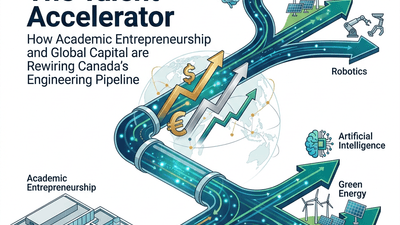



There was a time when the trajectory of a newly minted Canadian engineer was predictably linear: complete a rigorous undergraduate degree, secure an entry-level position at an established firm, and spend a decade quietly climbing the technical ranks. In 2026, that linear path has been entirely disrupted. Today, the gap between a final-year academic project, a venture-backed startup, and a high-tech corporate career has virtually disappeared. Canada’s top engineering institutions are no longer just graduating students; they are incubating commercial enterprises and acting as powerful magnets for foreign direct investment.
Recent developments across Ontario highlight this accelerating trend. From high-stakes undergraduate pitch competitions to significant global ranking leaps and multi-million-dollar regional investments, the Canadian engineering ecosystem is demonstrating a tightening feedback loop between academic excellence and industrial commercialization. For established engineering professionals and firm leaders, understanding this new "talent accelerator" is critical to remaining competitive in both recruitment and innovation.
The Capstone Commercialization Engine
The traditional senior year "capstone" project has historically served as a purely academic exercise—a final test of technical competency before graduation. However, institutions are increasingly transforming these projects into launchpads for viable businesses.
This shift was on full display at the recent 2026 Norman Esch Entrepreneurship Awards for Capstone Design, where twelve fourth-year engineering teams from the University of Waterloo competed for critical seed funding. Pitching innovative solutions to a panel of seasoned industry judges, these students weren't just defending their technical methodologies; they were defending their business models, market fit, and scalability.
The result? Over $100,000 was awarded to these emerging student-led ventures. This isn't just scholarship money; it is early-stage venture capital that empowers young engineers to bypass the traditional employment market and build their own firms right out of the gate.
"When an engineering faculty treats capstone projects as legitimate startup incubators, it fundamentally changes the psychology of the graduate. They enter the workforce not as passive employees, but as commercially aware problem-solvers."
Why This Matters for Established Firms
For Canadian engineering firms relying on fresh talent, this entrepreneurial pivot presents both a challenge and an opportunity. Top graduates are increasingly evaluating traditional job offers against the prospect of securing seed funding for their own ideas. To attract this caliber of talent, established firms must offer more than competitive salaries—they must offer environments that foster "intrapreneurship," allowing young engineers to take ownership of innovative, high-impact projects.
Global Validation Drives Industrial Investment
The commercial viability of Canada's engineering students is underpinned by the rising global prestige of the institutions training them. Academic rankings are often dismissed as mere vanity metrics, but in the realm of global engineering, they act as critical leading indicators for foreign direct investment (FDI) and corporate expansion.
Recently, the University of Waterloo climbed to 38th place globally in the 2026 Quacquarelli Symonds (QS) world subject rankings for engineering and technology. This significant jump places the institution firmly among the global elite, signaling to international tech and engineering conglomerates that Canada is a premier destination for advanced R&D and technical talent.
When a Canadian institution breaks into the top 40 globally, it triggers a tangible economic ripple effect. Multinational firms use these rankings to strategically plot their next regional headquarters, R&D centers, and talent acquisition hubs. They know that to build cutting-edge digital solutions, advanced manufacturing systems, or clean-tech innovations, they must anchor themselves near a proven, globally recognized talent pipeline.
The Regional Blueprint: FDI Meets Specialized Talent
We are already seeing the real-world manifestation of this global validation. International firms are not only targeting Canada's major metropolitan centers but are strategically investing in regional hubs that offer specialized engineering ecosystems.
A prime example is the recent announcement that global engineering and digital solutions company SOLIZE PARTNERS is investing nearly $2 million in Windsor's engineering industry. This strategic capital injection is slated to create approximately 40 new high-tech engineering and technical jobs in the region.
The Strategic Value of Windsor
Why Windsor? Historically known as Canada's automotive capital, Windsor is currently undergoing a massive transformation into a hub for next-generation mobility, advanced manufacturing, and digital engineering solutions. SOLIZE PARTNERS' investment underscores a vital trend: global companies are recognizing the untapped potential of Canada's legacy industrial cities, which are rich in foundational engineering knowledge and are rapidly upskilling for the digital era.
- Proximity to Manufacturing: Windsor offers immediate access to the North American automotive and advanced manufacturing supply chain.
- Digital Integration: Investments from firms like SOLIZE bridge the gap between traditional mechanical engineering and modern digital/software solutions.
- Ecosystem Synergy: The influx of high-tech jobs creates a localized ecosystem that helps retain talent drawn from regional and national top-tier universities, preventing the "brain drain" to the US or major tech centers.
Navigating the New Talent Paradigm
For engineering leaders, project managers, and firm partners across Canada, the convergence of academic entrepreneurship, rising global prestige, and targeted regional FDI requires a strategic recalibration. The pipeline has evolved, and the strategies for engaging with it must evolve as well.
| Element | The Traditional Pipeline | The 2026 Paradigm |
|---|---|---|
| Capstone Projects | Academic requirement; theoretical focus. | Commercial incubators; seed-funded startups. |
| Graduate Mindset | Seeking stability and long-term tenure. | Seeking high-impact, entrepreneurial opportunities. |
| Corporate Strategy | Passive recruitment at career fairs. | Active upstream engagement; capstone sponsorship. |
| Regional Focus | Concentration in Toronto, Vancouver, Montreal. | Expansion into specialized hubs like Windsor. |
Actionable Strategies for Engineering Leaders
- Move Recruitment Upstream: Waiting until a student graduates is too late. Firms should actively sponsor capstone projects, provide industry mentorship, and embed themselves in university ecosystems. By acting as early-stage partners, firms can build relationships with top talent before they hit the open market.
- Embrace Regional Clusters: As global firms like SOLIZE invest in secondary markets like Windsor, domestic firms should re-evaluate their geographic footprints. Establishing satellite offices or remote teams in these revitalized industrial hubs can provide access to specialized talent at competitive operational costs.
- Foster Intrapreneurship: To retain graduates accustomed to pitching for $100K seed funds, firms must create internal pathways for innovation. Allow junior engineers to pitch internal projects, lead small task forces, or dedicate a percentage of their time to R&D.
Conclusion: The Symbiosis of Academia and Industry
The Canadian engineering landscape of 2026 is defined by its interconnectivity. The University of Waterloo's ascent in global rankings and the entrepreneurial triumphs of its students at the Esch Awards are not isolated academic victories; they are the very catalysts that draw multi-million-dollar investments from global players like SOLIZE PARTNERS into our regional economies.
As we look to the future, the strength of Canada's engineering sector will not be measured solely by the infrastructure we build or the resources we extract, but by how effectively we nurture, commercialize, and deploy our human capital. For engineering professionals, the message is clear: the talent accelerator is running at full speed. Those who learn to engage with this dynamic pipeline—by fostering entrepreneurship and embracing regional innovation—will lead the next era of Canadian engineering excellence.