
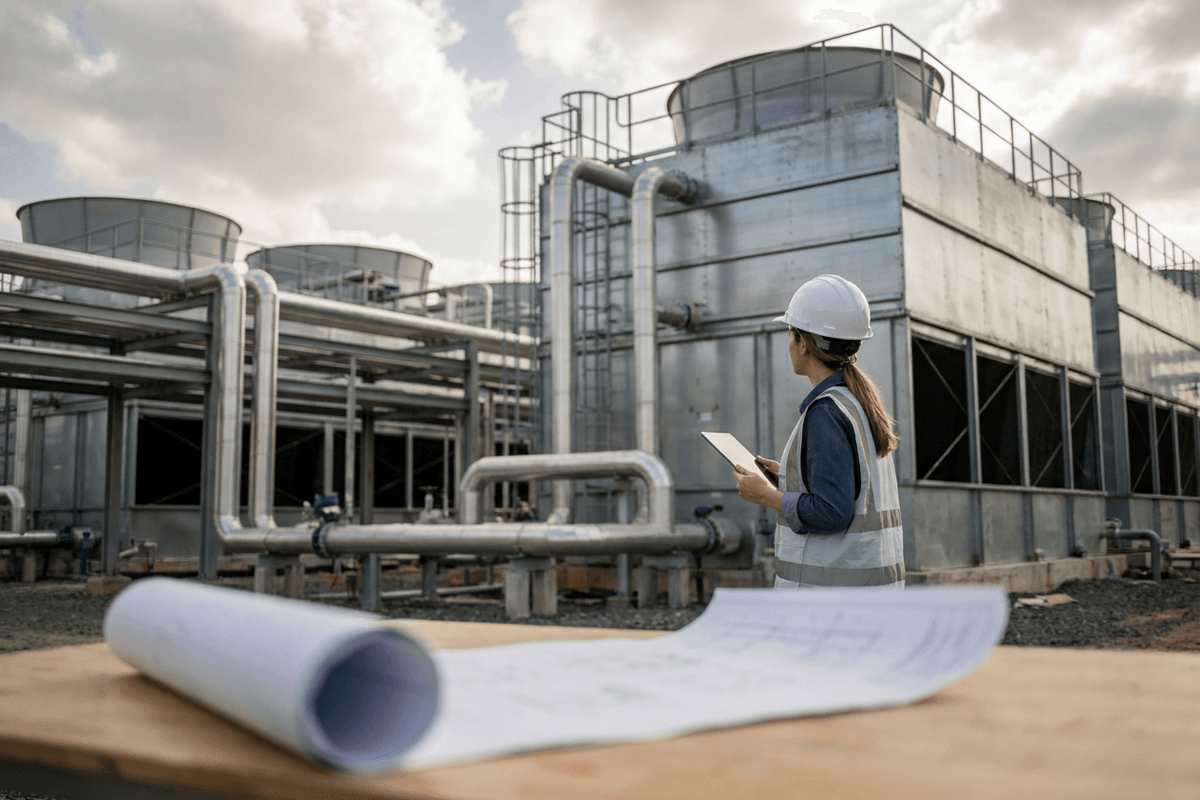

When Carrier announced plans to commit more than $600 million over the next three years to build a new advanced manufacturing and engineering center in Fort Worth, Texas, it signaled far more than a routine corporate footprint expansion. The initiative—slated to generate 1,500 high-skilled engineering and technical manufacturing jobs—reflects an urgent industrial pivot across North America. Driven by extreme computational densities in artificial intelligence clusters and aggressive industrial electrification, thermal engineering has transitioned from an auxiliary building systems trade into a critical frontline discipline for U.S. infrastructure.
For engineering managers, systems integrators, and specialty trade contractors, this capital influx underscores a decisive structural realignment. As conventional commercial construction moderates, the industrial engineering sector is reorganizing around three intertwined vectors: next-generation mission-critical thermal management, transmission-level grid hardening, and high-spec mechanical, electrical, and plumbing (MEP) execution.
The AI Thermal Chokepoint: Why Cooling Capacity Dictates Megaproject Schedules
The engineering physics governing modern data centers and advanced manufacturing plants have shifted fundamentally over the past 24 months. Standard air-side cooling architectures, historically engineered to dissipate 10 to 15 kilowatts (kW) per server rack, are rapidly being outpaced by high-density AI clusters that generate upwards of 40 kW to 100+ kW per rack. Meeting these thermal loads demands complex direct-to-chip liquid cooling loops, immersion chillers, and closed-loop evaporative cooling towers capable of operating at sustained volumetric efficiencies.
This dynamic is fundamentally altering mechanical design workflows. According to the latest 2026 North American Engineering and Construction Outlook, broad-based softening in traditional residential and light commercial development is being aggressively countered by double-digit capital growth in power generation, grid infrastructure, and hyperscale data center facilities. Engineering firms that once focused on conventional commercial HVAC fit-outs are rapidly pivoting their design practices toward mission-critical fluid dynamics, variable-refrigerant volume (VRV) platforms, and heavy industrial thermal loops.
"Thermal management is no longer merely a facility comfort metric; it has become the direct gating item for computational uptime, compute density, and return on industrial capital."
Carrier’s Fort Worth facility will serve as both a heavy manufacturing hub and a dedicated research and development center, engineered to compress the lead time between computational fluid dynamics (CFD) modeling and field-deployable commercial cooling skids. By anchoring engineering labs directly adjacent to advanced automated production lines, the facility targets one of the most stubborn bottlenecks in mission-critical project execution: equipment qualification latency.
Grid Resilience and the $967 Million Federal Counterweight
Manufacturing ultra-high-efficiency thermal equipment is only half the equation; integrating these power-intensive systems without destabilizing local utility infrastructure represents an equally complex systems engineering challenge. Recognizing the immense strain placed on regional balancing authorities by both industrial expansions and climate extremes, federal energy authorities are accelerating grid modernization investments.
The U.S. Department of Energy (DOE) recently announced approximately $967 million through its Grid Resilience formula grant program to fund state, territorial, and tribal engineering initiatives designed to harden power systems against extreme weather, reduce outage durations, and expand bulk power transfer capacity.
Key Technical Focus Areas of Grid Resilience Grants
- Substation Hardening and Automation: Upgrading digital protective relays, deploying optical current transformers, and elevating physical assets to withstand catastrophic flood levels.
- Dynamic Line Rating (DLR) Deployment: Installing real-time sensor suites along congested transmission paths to safely increase throughput without requiring immediate right-of-way reconductoring.
- Distributed Energy Resource (DER) Integration: Engineering microgrid switchgear and utility-scale battery energy storage systems (BESS) at industrial-utility interconnection points.
For systems engineers designing heavy industrial and data center campuses, these formula grants provide a vital bridge. As mega-facilities demand hundreds of megawatts of continuous baseload capacity, coordination between facility-level thermal systems and utility-side grid protection schemes is becoming a standard engineering requirement.
The Specialty Contractor Squeeze: Navigating the Technical Labor Deficit
While capital investments and federal grants provide the financial framework, actual project delivery remains constrained by field execution capacity. As documented in Engineering News-Record's Top 600 report on specialty contracting, the unprecedented acceleration of AI data center construction is driving record revenues across mechanical and electrical trades, but it is simultaneously placing intense strain on the qualified engineering talent pool.
The convergence of advanced chilled-water loops, mission-critical electrical distribution, and stringent acoustic and environmental standards requires a specialized cross-disciplinary skill set that remains in short supply across major industrial corridors.
| Engineering Sector | Primary Demand Driver | Primary Technical Bottleneck | Strategic Delivery Response |
|---|---|---|---|
| Thermal / HVAC Systems | AI compute density & industrial electrification | Chiller lead times & direct-to-chip plumbing integration | Modular offsite pump skids & CFD pre-validation |
| Electrical Substation & Power | Data center megaprojects & grid interconnection | High-voltage transformer backlogs & protection engineers | Dynamic line rating & multi-year advance procurement |
| Specialty MEP Construction | Complex mission-critical buildouts | Shortage of BIM/VDC coordinators & commissioning agents | Prefabricated modular multi-trade racks & digital twins |
To overcome this labor and capacity friction, leading engineering firms are leaning heavily into Virtual Design and Construction (VDC) and modular offsite prefabrication. Rather than assembling intricate chiller piping, valve trains, and variable frequency drive (VFD) enclosures entirely on active job sites, contractors are shifting work into controlled manufacturing environments—mirroring the integrated delivery approach exemplified by Carrier’s new manufacturing campus.
Engineering Implications: What Systems Designers and Managers Must Do Now
As the intersection of HVAC manufacturing, power grid stability, and high-density computing redefines industrial capital deployment, engineering teams must adapt their technical playbooks. Five operational priorities have emerged for firms navigating this market:
- Standardize on Modular Thermal Architecture: Shift facility design from bespoke, field-fabricated mechanical rooms toward repeatable, factory-tested modular chiller and pump skids that reduce commissioning cycles from months to weeks.
- Incorporate Grid-Interactive Demand Response: Design plant controls and thermal storage systems capable of shaving peak loads or transitioning seamlessly to localized battery storage during grid curtailment events.
- Cross-Train Mechanical and Electrical Disciplines: Break down organizational silos between high-voltage electrical engineers and fluid thermal designers to accelerate root-cause analysis during integrated system testing.
- Leverage Digital Twins for Commissioning: Utilize calibrated building information models (BIM) integrated with real-time sensor telemetry to perform virtual factory acceptance testing (FAT) before hardware arrives on site.
- De-Risk Critical Path Component Procurement: Establish long-lead equipment procurement frameworks early in schematic design, hedging against component backlogs for custom chillers, fluid coolers, and high-spec switchgear.
The Path Ahead
Carrier’s $600 million bet in Fort Worth serves as a bellwether for the future of American industrial engineering. The race to power and cool the next generation of artificial intelligence, high-tech manufacturing, and electrified infrastructure is fundamentally reshaping capital allocation, factory tooling, and field execution. For engineering leaders, success over the remainder of the decade will belong to those who master the full thermodynamic and electrical spectrum—from the silicon chip surface out to the substation fence line.