
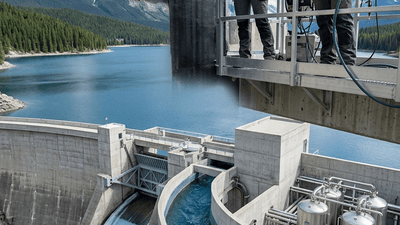



Water is the great equalizer in civil and environmental engineering. It is simultaneously the most destructive force acting upon our built environment and the most vital resource required to sustain human operations. For Canadian engineering professionals, mastering the "water nexus"—the dual mandate of repelling water to protect infrastructure and purifying it to secure operational capabilities—has become a defining technical challenge of the decade. Recent movements within Canada's WaterTech and structural materials sectors highlight a sophisticated evolution in how we manage this critical asset, shifting the focus from temporary fixes to permanent, lifecycle-integrated solutions.
Defending the Foundation: The Rise of Integral Crystalline Waterproofing
In the realm of structural engineering, particularly in the notoriously wet climates of Western Canada and the Pacific Northwest, concrete degradation due to water ingress remains a multi-billion-dollar liability. Traditional exterior membrane systems, while historically standard, are susceptible to puncture, deterioration, and installation errors. The industry is currently witnessing a massive pivot toward integral solutions.
This shift is underscored by recent executive movements at the forefront of the sector. Vancouver-based Kryton International, a global pioneer in crystalline waterproofing technologies, recently announced the promotion of John Anderson to vice president of sales. Anderson's elevation is notable not just as a corporate milestone, but as an indicator of market direction. His mandate has heavily focused on driving the adoption of crystalline waterproofing technologies across Western Canada and North America—a clear signal that the engineering and construction industries are ready to scale these advanced materials.
For structural and materials engineers, the mechanics of crystalline waterproofing represent an elegant departure from barrier-based thinking. Rather than wrapping concrete in a degradable envelope, these admixtures are integrated directly into the concrete mix. When exposed to water, the proprietary chemicals react with un-hydrated cement particles to form millions of needle-like crystals. These crystals permanently block the naturally occurring microscopic voids, pores, and micro-cracks within the concrete, effectively turning the structure itself into a waterproof barrier.
"We are moving away from the era of 'protecting the concrete' and entering the era of 'self-protecting concrete.' The integration of reactive crystalline technologies shifts the liability of water ingress from a fragile exterior membrane to the robust structural core itself, fundamentally altering the lifecycle calculus of major infrastructure projects."
This technological adoption is critical for Canada's ongoing mega-projects, from subterranean transit expansions in Vancouver and Toronto to deep-foundation high-rises contending with high water tables. By eliminating the need for external membranes, engineering teams are streamlining construction schedules, reducing petroleum-based material usage, and drastically cutting long-term maintenance liabilities.
Tactical Sustainment: Engineering Water Security for Defence Operations
While structural engineers battle to keep water out, environmental and defence engineers are tasked with capturing and purifying it under the most extreme conditions imaginable. In this arena, the engineering challenge is not just filtration, but ruggedization, mobility, and continuous sustainment.
This operational reality was recently highlighted by Ottawa-based BluMetric Environmental Inc., a Canadian WaterTech and environmental consulting firm. BluMetric recently secured a $2.9 million contract extension with the Canadian Department of National Defence (DND). The contract is specifically earmarked for the ongoing refurbishment, support, and maintenance of the military's Reverse Osmosis Water Purification Units (ROWPUs).
The ROWPU systems are marvels of mobile environmental engineering. Designed to be deployed in austere environments—ranging from domestic disaster relief zones (such as post-flood deployments in British Columbia or the Maritimes) to overseas tactical operations—these units must seamlessly convert highly contaminated, brackish, or saline water into potable supplies.
However, the most critical aspect of the BluMetric contract is its focus: refurbishment and maintenance. In the complex world of defence engineering, procuring new equipment is only a fraction of the challenge. The true engineering test lies in lifecycle sustainment. Maintaining high-pressure reverse osmosis membranes, ruggedized pumps, and sensitive chemical dosing arrays in systems that are routinely subjected to extreme physical shock, temperature variations, and heavy particulate loads requires a highly specialized, multidisciplinary engineering approach.
The Strategic Shift: From Installation to Lifecycle Management
When we analyze the trajectories of both Kryton's crystalline technology expansion and BluMetric's DND sustainment contract, a unified theme emerges for the Canadian engineering sector: the transition from CapEx (Capital Expenditure) installation to OpEx (Operational Expenditure) lifecycle management.
Whether dealing with static concrete foundations or mobile filtration plants, Canadian engineering firms are being tasked with extending the viable lifespan of critical assets. This requires a fundamental shift in design philosophy, prioritizing durability, self-healing properties, and modular maintainability from day one.
| Engineering Domain | Key Canadian Player | Core Technology | Primary Engineering Objective |
|---|---|---|---|
| Structural / Civil | Kryton International | Integral Crystalline Waterproofing | Asset longevity, concrete durability, and eliminating exterior membrane failure points. |
| Environmental / Defence | BluMetric Environmental Inc. | Reverse Osmosis Water Purification (ROWPU) | Tactical resource security, modular ruggedization, and lifecycle system refurbishment. |
Key Takeaways for Canadian Engineering Professionals
As the industry navigates this water nexus, engineering leaders must adapt their strategies to align with these emerging technological paradigms:
- Re-evaluate Material Specifications: Structural engineers and specifiers should increasingly look beyond traditional barrier methods. Assessing the lifecycle cost-benefit of integral admixtures like crystalline waterproofing can drastically reduce long-term client liabilities.
- Design for Sustainment: The BluMetric DND contract proves that the "tail" of a project (maintenance and refurbishment) is often longer and more lucrative than the "tooth" (initial procurement). Mechanical and environmental engineers must design systems with modularity and field-serviceability as primary constraints.
- Cross-Pollinate Expertise: The solutions to complex water challenges are rarely siloed. The chemistry of concrete admixtures and the fluid dynamics of reverse osmosis both require a deep integration of chemical, mechanical, and materials engineering.
Looking ahead, Canada's geography and climate will continue to serve as the ultimate proving ground for water-related engineering technologies. By exporting these hard-won innovations—from Vancouver's self-healing concrete to Ottawa's tactical purification systems—Canadian engineering firms are not just reacting to the elements; they are dictating the terms of engagement. For the modern engineer, mastering this water nexus is no longer just a specialized niche; it is the baseline for building resilient, future-proof infrastructure.